What Answer Shall Be Given?
The existence of the modern state of Israel is not merely historical happenstance. It was realized in accordance with the declaration of the God of Israel through His prophets. In fact, every significant event in the history of Israel has been foretold by the prophets of the Lord. They saw glimpses of the future, fragmented visions of God's redemptive plan. Why did He disclose these future events? He did it so that Israel would know that He alone is God, and that they should obediently trust in His promises to them. As He says, "I have declared the former things from of old; yes, they went forth out of my mouth, and I showed them: suddenly I did them, and they happened... I have declared it to you from of old; before it came to pass I showed it to you." (Isaiah 48:3,5 WEB) But not only did He tell them of events of those days, He also announced events of the distant future.
The establishment of the modern nation of Israel, the restoration of the land to the Jewish people, and the regathering of the people from around the world were all foretold and described in detail in the Bible. But, if in fact God speaks concerning all major occurrences for Israel, what has He said about the current "peace process?" The Bible does speak of a time when Israel, after having been gathered back into the land, will "live in safety," free from concern about their "malicious neighbors."
'"No longer will the people of Israel have malicious neighbors who are painful briers and sharp thorns. Then they will know that I am the Lord God." This is what the Lord God says: "When I gather the people of Israel from the nations where they have been scattered, I will show myself holy among them in the sight of the nations. Then they will live in their own land, which I gave to my servant Jacob. They will live there in safety and will build houses and plant vineyards; they will live in safety when I inflict punishment on all their neighbors who maligned them. Then they will know that I am the LORD their God."' (Ezekiel 28:25-26)
Could this really happen? Will Israel really experience what the prophet describes: the removal of their "malicious neighbors?" The people of Israel have returned to "live in their own land," but they do not now live in safety. Soon, however, they will, after the Lord "inflicts punishment" on those who clamor for their destruction. Notice that this does not happen as a result of the ill-advised "peace process" with the Palestinians. Indeed, the prophet Isaiah has instructions for Israel about the proper response to the Palestinian representatives.
It is common knowledge that today's Palestinians have identified with the Philistines of ancient times, even though there is no direct physical link. They see themselves as the successors to that group, which contended with the Israelites for that same land. In fact, if you listen to an Arab-speaking person refer to "Palestine", it is pronounced "Philistine" in Arabic.
In a reference to those "Philistines," (or as the King James Version translates, "whole Palestina") Isaiah provides us with a question that prophetically refers to the current peace process with the Palestinians. In chapter 14, Isaiah asks this question: "What answer shall be given to the envoys of that nation?"
This Scripture is one of God's replies to the claims of today's Palestinians for the land of Judea and Samaria. The "answer" to be "given" is in response to their impudent demands for land that God had promised to Abraham, Isaac, and Israel.
Examine the question. An envoy is a representative, a messenger, an ambassador. "That nation" is the Palestinians. So, we see a group of Palestinian envoys waiting for an answer to their demands. But the answer is not one that will be to their liking. It comes from God Himself.
What answer shall be given to the envoys of that nation? "The Lord has established Zion, and in her his afflicted people will find refuge." (v. 32 NIV)
How shall we answer the messengers that come to us from Philistia? We will tell them that the Lord has established Zion and that his suffering people will find safety there. (v. 32 GNT)
What an answer! The modern nation of Israel, which came into being in 1948, was a direct act of God. He established it, not the Zionists alone. It was His doing to found it, and He did it to provide a place of refuge for His afflicted people! In this one short incredible verse, we see implicit historical references to the suffering the Jewish people endured throughout history, culminating in the Nazi holocaust, and to the fact that the nation of Israel was founded in response to that suffering. After so many centuries of being afflicted wanderers among the nations, they finally have their homeland back, the land that was promised to their fathers. God did it, and He is not about to retract His sworn pronouncement!
Oh, if only the Israeli government officials would throw away their foolish offers of appeasement, and simply quote this phrase to the Palestinians! "The LORD has founded Zion, and the afflicted of His people will find refuge in it."
They Arrogated My Land
Among the many prophecies in the Bible that deal with specific times and places, we see a wide range of historical fulfillment, some past, some future. Certain prophecies have languished in relative obscurity for a long time, awaiting the future day when all things written in them would be accomplished. Suddenly, as the time approaches and the setting for a particular prophecy begins to congeal, the words which had previously been ill-understood now jump out of the page at us.
Such is the case with Ezekiel 36. These words, especially the first 15 verses, comprise the most cogent, relevant, and unambiguous declaration by God Himself regarding the epic controversy of our day: the land which is being claimed for a Palestinian state, for which God has other intentions.
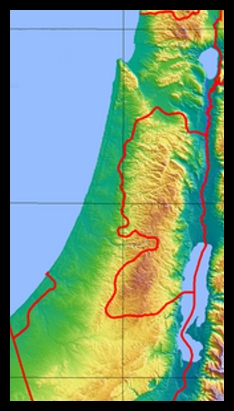 The first four verses consist of God describing the plight he is witnessing in what is correctly referred to as Judea and Samaria. Other terms that the world uses to described this land are "disputed territories", "occupied territories", and the "West Bank". In this prophecy, the terminology God uses to describe it is "the mountains of Israel", so there is no doubt as to exactly the area to which He is referring. This can be easily confirmed by examining the topographic map to the right.
Some have supposed that this chapter was fulfilled when Israel was founded as a nation in 1948, but not so. Though Israel is once again a nation, the land under consideration in this chapter is precisely the land upon which many plan to create a Palestinian state. The predicted clash between God and certain foes is about to realize culmination before our eyes.
A sense of drama is conveyed here. In any good drama, there is a protagonist, an antagonist, and an issue of conflict. Keep that in mind as we examine the verses in detail. Both the protagonist (God) the antagonists (the Palestinians and the nations who support them), and the conflict itself are portrayed in extreme terms in this prophecy. There is a resolution to the dramatic conflict foretold in these verses, a resolution that is as dynamic and extreme as the conflict itself.
It is not surprising, of course, that God would foresee and foreordain that this particular area of land would be a source of future conflict. Out of all of the places on earth, this relatively tiny patch of land that is the focus of world contention is also the focus of this intense prophetic word. Coincidence? No. That He singles this land out for special attention corresponds to the way the world has now singling it out for special attention. Once again, we see how accurate the prophetic Scriptures are. This convinces us that God does indeed foretell the future for our benefit, so we can once again be certain that all his words are trustworthy.
An interesting contrast exists between this chapter and chapter 6 of Ezekiel. Both are prophecies to "the mountains of Israel." Chapter 6 consists of a description of severe judgments that would befall the people of Israel in Ezekiel's day, with extended consequences in exile. Chapter 36 is the opposite -- a description of "severe" reclamation of the land and the people.
In this commentary, I will present an extended paraphrase based on the 17 English translations I am using as reference in addition to a Hebrew dictionary. I will use the literal transliterations for the names for God.
"Now you, son of man, prophesy to the mountains of Israel and say, 'O mountains of Israel, hear the word of Yahweh. This is what Adonai Yahweh says:".... (v 1)
We can discern a very strong emphasis that this pronouncement regarding the "West Bank" is a forthright message from God, based on the fourfold emphasis of the terminology concerning speaking and listening to his word. In contrast to the many voices we hear today propounding various proposals, plans, accords, agreements, and resolutions for a Palestinian state solution, stands the declaration of El Shaddai. There is no negotiation possible with this Divine decree. It stands forever in heaven, inalterable, inflexible, unyielding.
"Because the sneering, gloating, hateful enemy has spoken against you, 'Hah! Those ancient hills have become our possession!'"... (v 2)
First, God makes his case against the antagonist, who is clearly enjoying in a spiteful manner the temporary claim he has laid on the land of the Bible. Though the enemy declares that the land in question belongs to him, there is no indication that this claim has been fully effected. This coincides with the present situation, where the Palestinians maliciously assert the land is for their state, which will not happen. I repeat, it will not happen, there will never, never, never be a Palestinian state, not tomorrow, not next year, never!
"Very well then, prophesy and say, 'Because, yes because, they ravaged you, and greedily, eagerly, lustfully panted after you and seized you from every side, as if you had been delivered up as property of the rest of the nations, and become the topic of those nations' disparaging, malicious discussions and slander, '"..... (v 3)
God's decree which is about to follow is in response to the outrageous actions and attitudes of the Palestinians, in league with the so-called "Quartet": the United Nations, the European Union, Russia, and the United States. The double "because" is for extra emphasis, to indicate that God is entirely justified in the sentence he is about to pronounce against the hostile parties. Those parties have presumptuously supposed that they have the right to make the final disposition of that land, to create a Palestinian state on land that was promised on oath to Abraham, Isaac, and Israel. Notice also the reference to the atrocious slander against the "settlers", those brave Israelis with the audacity to live in their covenant land.
"Therefore, O mountains of Israel, hear the word of Adonai Yahweh: This is what Adonai Yahweh says to the mountains and hills, to the ravines and valleys, to the devastated wastelands and the and the forlorn, deserted towns that have become the scorned prey and derisive laughingstock to the rest of the nations around you-- this is what Adonai Yahweh says:..." (v 4)
Notice the threefold repetition of the divine names. We again see the emphasis, if it has not yet registered clearly with us, that these pronouncements are coming from none other than the Holy One on the throne of heaven.
Once again, God is directing his prophecy at the very hills where the patriarchs roamed, where at one time many populated towns full of Jews thrived during the period of the kings of Israel and Judah. Ezekiel presided as a messenger of God at the end of that era. He had been shown earlier the ultimate consequences of Israel's persistent rebellion against God -- the Beautiful Land would become largely a deserted wasteland.
And it did. But Ezekiel is also shown a vision of future recovery. It is not the past devastation, but the the modern radical hostility of the surrounding Arab nations to which God is directing his attention. Hatred seems too inadequate to describe the excessive, toxic contempt which the Arab/Muslim world holds for the Jewish nation in their midst. It is this extreme loathing for Israel that rouses God to the extreme white-hot pronouncement he is about to make in the next verses.
"Assuredly, in the blazing heat of my zealous wrath I have spoken out against the other nations, and especially against all Edom, for with wholehearted glee and with contemptuous malice in their hearts they arrogated My land as their own possession so that they might plunder its pastureland and justify their claim that (the Jews) have been cast out as prey." (v 5)
This, the beginning of God's detailed response to the Palestinians and the rest of the nations that support their nefarious goals, could hardly be more scathing or emphatic. It is important to point out the intensity of the emotional commitment that God himself is expressing in reaction to the utter scorn, the "disdain of soul" of the Arab Muslims.
"All Edom" is singled out, which we may recall from the prior companion chapter 35, is the Muslim Arab world. Once again the charges against them and the nations are presented, charges penned 2600 years ago that accurately resound today.
The question of to whom does the land belong is concisely rejoined: "My land." Since it is Yahweh's property, he can assign it to whomever he wishes, despite Allah's baseless assertions to the contrary. All of the laughable arguments that the Palestinian spokespersons concoct are powerfully refuted here, and will be effectually refuted as well when God fully executes the intentions described.
"Therefore speak your prophetic word over the land of Israel and say to the mountains and hills, to the ravines and valleys: 'This is what Adonai Yahweh says: 'I speak in my furious, jealous rage because you have suffered the scorn of the nations, insulting and humiliating you. Therefore this is what Adonai Yahweh says: I swear with uplifted hand that the surely the nations that surround you will also suffer scorn, shame, humiliation, and disgrace." (v 6-7)
The CEV translation ends that last portion with "I will now insult and disgrace them. That is my solemn promise." Peterson's "The Message" puts it, "it is their turn to be humiliated." Can there be any doubt what the God of Israel is about to do to the Arab Muslim nations because of their outrageous offenses against the land and people of Israel? Once again we see profound emotions in full view. The breathtaking ferocity of the vow that God swears should be enormously frightening to anyone about to experience the brunt of it.
"'But you, O mountains of Israel, will shoot forth your branches and yield your fruit for my people Israel, for they have drawn near to soon come home. Truly I am for you and will look on you with favor; you will be cultivated and sown. I will multiply the number of people upon you, a large population, the whole house of Israel, yes, all! The ruined towns will be rebuilt and inhabited. I will increase your population, both humans and animals upon you, and they will be fertile and become numerous. I will settle people on you as in earlier times and bring you even greater benefits and prosperity than at your beginnings. Then you will know that I am Yahweh." (v 8-11)
In a remarkable change of tone, the Lord begins to speak tenderly and consolingly to that land. Affirming his care and concern, he indicates the initiation of a new era of blessing and favor, with his objective that Israel realizes it was he who accomplished all these things. Once all notions of a Palestinian state upon that land are forever banished to the annals of history, God will perform astonishing feats of goodness to that land and the people there. The brown, rocky, barren hills will once again bloom and be resplendent with green.
"'I will cause people, my people Israel, to walk upon your soil again. They will possess you, and you will be their inheritance; you will never again bereave them of their children.' This is what Adonai Yahweh says: 'Because people say about you, "You devour men and bereave your nation of its children," therefore you will no longer continue to devour men or make your nation childless,' declares Adonai Yahweh." (v 12-14)
"You are a man-eater" is how the NJB translation reads. But it is not the land that is guilty; it is the terrorists who live there. Thus, in these verses the Lord directly addresses the problem of Palestinian terrorism. Normally, it should not be extraordinary that people would walk upon that land. But currently they cannot, because most places in the West Bank are extremely dangerous for Jews. To solve that problem. God says he is going to eliminate the terrorists from that land. Mothers will never again weep after being deprived of their children through cruel, cold-blooded terror attacks from Muslims in the name of Allah.
"And I shall never again let you hear insults from the nations anymore, nor will you bear the taunts from the peoples any longer, nor will you cause your nation to stumble any longer," declares Adonai Yahweh.'" (v 15)
Now the picture is complete. After God finishes all that he has said in this section, there will be no more abusive, unwarranted talk about how the Israelis are the cruel occupiers of an oppressed people. All of Judea and Samaria will become an official part of the state of Israel, occupied by multitudes of Jewish people. The land itself will blossom in seemingly miraculous ways. Hebron, Shechem, Bethel, Bethlehem, and scores of other towns will be thriving Jewish communities, ready for a new influx of Jews to make aliyah there. Ramallah and Nablus and Jenin will be dusty, empty wrecks to serve as a reminder of the absurdity of opposing the God of Israel.
However, the last phrase of verse 15 may seem curious at first. How did that land cause the nation of Israel to stumble? Israel stumbled by not placing their confidence in the God who still cares for them, choosing instead to place their faith in foolhardy and destructive "peace plans". Not only were those plans doomed from the start because the Palestinians never had any intention of renouncing violence; more importantly, they were a betrayal by Israel of their historical and Biblical heritage to those lands. Snubbing the God who birthed Israel originally and who regathered Israel back in modern times, they chose to ignore his promises once again.
The God who graciously granted those lands long ago to Abraham cannot be pleased that Israel for a time largely relinquished that land grant in favor of the Oslo process. "Land for peace" was an abomination because of the land itself that was being offered up, the land addressed in this prophecy. This is how that land caused Israel to stumble. Yet after what is written here in Ezekiel 36 has been accomplished, we pray that Israel will have the hindsight to see what God was doing all along. He is renewing his compassion for Israel, and is revealing himself as the loving God whose mercy endures forever.
Like Dew From The LORD
The remnant of Jacob will be in the midst of many peoples like dew from the LORD, like showers on the grass, which do not wait for man or linger for mankind.
The remnant of Jacob will be among the nations, in the midst of many peoples, like a lion among the beasts of the forest, like a young lion among flocks of sheep, which mauls and mangles as it goes, and no one can rescue.
(Micah 5:7-8 NIV)
In the writings of the prophet Micah, we find two poignant similes that relate to present day Israel. Both of these potent heavenly maxims speak of a "remnant of Jacob" that exists "among the nations." These meaningful phrases both identify the current nation and hint at its isolated status. The Hebrew word he'eriyth, for "remnant," connotes "a remainder or residual surviving portion." Therefore, we conclude that this phrase is referring to the nascent state of Israel that came into being as a refuge for Jews in the wake of the holocaust.
Both of these object lessons regarding the origins and attributes of the Jewish state are presented by Micah as future statements of fact, as evidenced by the words "will be." The first simile indicates Israel will exist among the nations "like dew from the Lord." Dew in the morning is not an outcome that any human plans or executes. Though we could explain in scientific terms how condensation occurs when the interaction between humidity and temperature reach a certain point, we can just as easily and accurately say that God put it there. When you awake in the morning and look at the grass, there is the dew.
It is the same with Israel. Though we could explain in political and military terms the factors, planning, and actions that contributed to the founding of the state, we can just as easily and accurately say that God put it there. When the world awoke on that special morning in May 1948, there was the nation of Israel.
Micah reinforces this point by saying that the dew and showers on the grass "do not depend upon people or wait for any mortal." (NRSV) God accomplished it, despite the opposition and ire of many nations that exerted greatly to prevent it. Now Israel sits among those nations like dew on the grass.
Dew also signifies a time of refreshing. Thirsty and withered leaves, which had endured the heat of the previous day, welcome the new morning with the fresh coolness of the dew. The "times of refreshing" for Israel is a phrase we find elsewhere in the Bible, speaking of the end-times. Dew from the Lord will spiritually revitalize and reinvigorate Israel after the previous long day of scorching heat, the long period of dryness and barrenness.
The second simile is very different from the first, but no less significant. While the first addresses the Divine inauguration and unwavering existence of the emerging state, the second speaks of the actions of that state of Israel after its establishment. Unlike the docile peoples who were repeatedly torn to pieces during the long period of exile, the regathered remnant of Jews in the land will be a lion. In the midst of the many hostile nations who hate Israel and spurn her existence, Israel will be no passive victim waiting for another beating. No, the rejuvenated nation will be a lion to those nations, mauling and mangling at will. Just as no creature in the wild dares challenge a lion when he is going about his business, so too will no one intervene to deliver the "beast" nations that Israel will trample and tear.
Notice that the Lord Himself is making these declarations, not Israel. Israel today would like nothing better than to live in peace with its neighbors. But those neighbors have for decades been unwilling to accept that Israel has a right to exist, and a right to possess the land that God has designated. As a result, those neighbors have been mauled and mangled in several wars. But an even more decisive victory is yet to come. When those malignant neighbors decide to push the issue one final time, they will experience the ultimate fulfillment of these succinct prophecies.
The Lord Himself provides the best summary in the next verse:
"Your hand will be lifted up in triumph over your enemies, and all your foes will be destroyed." (Micah 5:9 NIV)
Two Kinds
A March 31 open letter issued by the World Council of Churches denounced "repeated declarations by the (Israeli) government's top leaders" that "all of Jerusalem will belong to Israel". This organization, which represents a large portion of institutional Christendom, has for years stood in solidarity with the Muslim Arabs against what they call Israel's "illegal occupation of Palestine".
Yet for some Jews, the discrepancy is beginning to make more sense. In the progression of Jewish-Christian relations, an interesting development has occurred in recent years. During a conversation I had with a prominent Israeli leader, this person said, "We Jews now understand that there are two kinds of Christians -- those who love us, and those who do not".
This seems to be a new revelation for many Jewish people, who until recently viewed the Christian world as a somewhat monolithic entity. It was an entity correctly viewed as a primary source of extended misery for the Jews over the course of time.
Anyone familiar with history knows the awful record of horrid atrocities committed against the Jews by the "church". The use of that word in quotes is to distinguish between those deviant religious institutions and the true Church. The latter is supposed to be characterized by love, but somewhere in the process, attitudes towards the Jews were twisted into ecclesiastically sanctioned hatred.
How did this happen? As the concept of the church devolved from the simple, untainted spiritual assembly of believers to the foul, grotesque political monstrosity that dominated Europe for centuries, a theology of animosity towards Jews was fabricated.
Tragically, the church chose to ignore this divinely inspired directive, and instead constructed a theology of hatred for Jews. This theology taught the Jews were under God's eternal curse for rejecting Jesus as Messiah, and were to be actively condemned for the part their leaders played in Jesus' unjust execution. The church had become the new Israel, replacing the spurned Israel. Therefore, the Jews were to be blamed and scorned as "Christ killers".
As this warped doctrine pervaded the churches, taught universally for centuries, it incited extensive oppression, expulsion, and murder of Jews. The church, which was supposed to be exemplary in love, became exemplary in hatred.
In modern times, a segment of the church has taken a fresh look at the Bible, and renounced the theological concept the church has replaced Israel, along with all of the resultant viciousness. It has in repentance embraced the doctrine that all Jews are to be loved unconditionally, regardless of any difference in viewpoint on the identity of the Messiah. It has affirmed the message of the Biblical prophets that God still has auspicious intentions for the nation of Israel.
Notice that it is only a segment of the church which has renounced that theology. This is the basis behind my friend's accurate observation about the "two kinds of Christians". The replacement theology which was at the root of historic anti-semitism is still prominent in many church organizations and denominations.
Anti-Zionism is the modern expression of that old rotten creed. Israel has become a nation once again, in marvelous fulfillment of the pronouncements of the Biblical prophets. However, rather than giving the God of Israel his due renown for this momentous act, rather than applauding God's renewed compassion for the Jews expressed by returning them to their place of refuge, the replacement theologians persist in their hoary spite. They deny any connection between the Israel of the Bible and the Israel of today. They deny its legitimacy as a special preordained accomplishment of God's sovereign plan.
This is why the World Council of Churches, comprised of members who still promulgate that reprobate replacement theology, consistently issue anti-Israel proclamations. This is why these "Christians", who deny the Bible is the authoritative, inerrant Word of God, support a Palestinian state on land God promised in an eternal covenant to Israel. This is why these spiritual descendants of the ecclesiastical hate mongers demand that Jerusalem be wrested from Jewish possession. This is why these clerics find more in common with the descendants of Ishmael, who worship a foreign god and advocate jihad, than they do with the descendants of Isaac.
But no matter. They are grass. What God has said will prevail, regardless how many esteemed reverends contest it. "The grass withers and the flowers fall, because the breath of the LORD blows on them. Surely the people are grass. The grass withers and the flowers fall, but the word of our God stands forever." (Isaiah 40:7-8 NIV)
Yes, there are two kinds of "Christians". We are those who stand on the word of our God, who will be unconditionally supportive of Israel, based on the unconditional covenant promises to Abraham.
Isaiah 17
As we consider what God is doing to accomplish His pronouncements for the nation of Israel, we realize the process is far from complete. Through His compassion, the Lord has once again "chosen" Israel and begun to settle them in their own land. (Isaiah 14:1) Though many of the Jewish people are now back in that promised land, most do not acknowledge the One who performed it. There is little regard for the God of Israel, little acknowledgment of Him by most of the Israeli population. Israel is as godless and unholy a nation as any other in the world. And even those who do make an appearance of worshiping that God are operating in the framework of a man-made religious system which is not the gateway to an animate relationship with Him.
Yet we know from the Scriptures a dramatic change will occur in Israel, a spiritual revitalization unparalleled in world history. "I will pour out my Spirit on the house of Israel", declared the Lord God through the prophet Ezekiel. What will be the impetus for this dramatic transformation?
It will be a process similar to what many of us have experienced individually as the Lord brought us to Himself. We endured devastating circumstances that cast us into a desperate state, until all we could do was cry out to God for mercy and help. But it was His kindness that took us to that state, so He could restore us to Himself. In the Bible, we see this repeatedly in the ancient history of Israel.
Prophetically, we see it as well, in Isaiah chapter 17, which describes that future "day men will look to their Maker and turn their eyes to the Holy One of Israel." (v 7 NIV). This "looking" will be with new spiritual eyesight, imploring God for succor, in sincere repentance. The next verse indicates that Israel will no longer look to their man-made religion, "the works of their hands." But first, let us take a verse-by-verse examination of this chapter, which begins with a foretelling of doom for the city of Damascus, Syria.
The demise of Damascus is prophesied in three different places in the Bible. Isaiah 17 is one of them. If this prophecy is yet future, awaiting fulfillment, it could happen soon. Damascus is a central hub of terrorism today. Several of the most prominent terrorist organizations have their headquarters there, and coordinate their operations from there. With the United States and Israel aligning against Iran, Syria, and Hezbollah, it is not hard to see today how circumstances could quickly fall into place.
When examining Bible prophecy, the question is not "if" what God said will happen, but "when". So our initial question for this chapter is this: has the destruction of Damascus, described here, occurred in history?
(Isaiah 17:1 ESV) An oracle concerning Damascus. Behold, Damascus will cease to be a city and will become a heap of ruins.
(Isaiah 17:1 JPS) The burden of Damascus. Behold, Damascus is taken away from being a city, and it shall be a ruinous heap.
(Isaiah 17:1 NIV) An oracle concerning Damascus: "See, Damascus will no longer be a city but will become a heap of ruins.
Looking at these three different translations, we see the prophecy is not only about the destruction of Damascus, but the thorough dissolution of its status as a city. Its "cityhood" will be taken away. After this oracle is fulfilled, there will never be a city called Damascus again. If Isaiah had only said "Damascus will be destroyed", then presumably, it could be rebuilt. But the impact is stronger than that. "Damascus will be negated from being a city." (Stone Edition Tanach)
A phrase in verse three also confirms this. The sovereignty, the royal power, the kingdom "will disappear from Damascus." Though it is the seat of government, capital of Syria, that status will be removed, and it will no longer function as such.
So we see that this prophecy could not have taken place, or else Damascus would not now exist as a city. Yet some commentators claim this was historically fulfilled in 732 BC by the Assyrians under Tiglath-Pileser III. However, neither the Bible (which records the incident in 2 Kings 16:9) nor the ancient Assyrian inscriptions found at Ninevah say the city was destroyed, just captured. It certainly did not cease to exist.
Also, it is important to note that the three Biblical prophecies about the doom of Damascus (Isaiah 17, Jeremiah 49, Zechariah 9) were written over a span of 200 years. Therefore, even a fulfillment in Isaiah's day would not satisfy the requirements of the other prophecies, written later. Regarding Jeremiah's prophecy about Damascus, the Babylonians under Nebuchadnezzar did conquer the city in 605 BC, but there is no record of it being destroyed then. Neither did Zechariah's prophecy receive a fulfillment. Alexander the Great did also subsequently take Damascus in 332 BC, but without bloodshed or destruction.
Therefore, we can conclude that all three of these prophecies about Damascus are referring to a tragic event yet future. God does not tell us directly in this chapter His reasons for the severe pronouncement of doom against Damascus. But God is a just God, and does not take such drastic actions arbitrarily. Therefore, Damascus apparently does something to deserve this fate. Though the reasons are not directly stated, we might be able to infer them from dire circumstances that Israel suffers in the context. So our supposition is Damascus is responsible for those circumstances, as we shall see later.
As we continue in our verse by verse examination, this reference to "Aroer" is a bit puzzling. It is a region on the northern bank of the Arnon River in what is today Jordan. At the time of Moses, it marked the southern boundary of the territory given to the two and a half tribes who received their land inheritance on the east side of the Jordan River. That Aroer was in the territory of Reuben. There was another Aroer in the territory of Gad as well, very near Rabbah. Rabbah is today called Amman, the modern capital of Jordan. So Isaiah may be indicating that the Jordanians will be involved as well.(Isaiah 17:2 ESV) The cities of Aroer are deserted; they will be for flocks, which will lie down, and none will make them afraid.
Does this mean that the nation of Jordan will be party to whatever conflict causes the destruction of Damascus? The textual proximity of prophecies against Moab and Ammon (who resided in today's Jordan) in Isaiah 15-16 and Jeremiah 48-49 to the prophecies against Damascus provide circumstantial evidence for this. In fact, Jeremiah 49:1-2 uses similar terminology when describing the fate of Rabbah (Amman) as Israel regains possession of its land on the east bank of the Jordan. So it is possible that both Amman and Damascus will be destroyed in the same actions, and the "flocks that will lie down" there in safety are the Jews who will repossess that land.
Just as in the previous verse we saw a possible hidden reference to Amman, Jordan, here we see a possible hidden reference to the Palestinian Authority. The territory allocated to the tribe of Ephraim sits at the very heart of the so-called "West Bank". So the "fortifications" described in verse 3 are probably a symbolic reference to the terrorist strongholds that will be eliminated. If Isaiah were writing it today, he might say, "The PLO forces will vanish from the West Bank."(Isaiah 17:3 ESV) The fortress will disappear from Ephraim, and the kingdom from Damascus; and the remnant of Syria will be like the glory of the children of Israel, declares the LORD of hosts.
This seems to hint that the Palestinians as well will be involved in whatever events lead to the destruction of Damascus. At the same time the governing authority disappears from Damascus, the military units of the Palestinians disappear from the West Bank. "Not a sign of a fort is left in Ephraim, not a trace of government left in Damascus." (v. 3, The Message Bible)
The final phrase in verse 3, "the remnant of Aram will be like the glory of the sons of Israel," is another emphatic statement about the scope of the judgment against Syria. Isaiah was writing in the days when the Assyrians had devastated the northern kingdom (ten tribes) of Israel. So Isaiah is saying that Syria's ultimate fate would be similar.
In the next section, the focus changes from Damascus to Israel. In fact, Damascus is not even directly mentioned in the rest of the chapter. However, because of the structure of this oracle, we surmise that the effects on Israel described in the remaining verses are in conjunction with the conflict with Damascus.(Isaiah 17:4-6 NIV) "In that day the glory of Jacob will fade; the fat of his body will waste away. It will be as when a reaper gathers the standing grain and harvests the grain with his arm-- as when a man gleans heads of grain in the Valley of Rephaim. Yet some gleanings will remain, as when an olive tree is beaten, leaving two or three olives on the topmost branches, four or five on the fruitful boughs," declares the LORD, the God of Israel.
Isaiah uses several metaphors to describe the consequences on Israel. Some of those consequences are very negative, but they lead to a positive spiritual revolution described in verses 7-8.
But first, the negatives. Verse 4 describes a process of enfeeblement and emaciation for Israel. Then verses 5-6 depict visuals of privation and desolation. This desolation seems to effect Israel's "strong cities", according to verse 9. This would be a reference to Israel's population center on the Mediterranean coast, where the major cities are. Later on in the chapter, Isaiah calls it "a day of grief and incurable pain."
How might we interpret these scenes, given the context? It seems plausible that the destruction leveled against Damascus is God's response to devastation it has wreaked upon Israel's population center, the "strong cities". Those cities will be like "deserted places", according to verse 9 -- "all will be desolation".
If this is the correct interpretation of these verses, it means a great deal of sorrow and suffering for many people. But out of this suffering comes a remarkable spiritual transformation in Israel.
God will apparently use the desperate circumstances to turn the gaze of Israel to Himself. This seems to be the answer to the question "what will it take for the nation of Israel to come back to their God?" It is confirmed in Zechariah 9 as well, one of the other places where doom is declared upon Damascus.(Isaiah 17:7 -8 ESV) In that day man will look to his Maker, and his eyes will look on the Holy One of Israel. He will not look to the altars, the work of his hands, and he will not look on what his own fingers have made, either the Asherim or the altars of incense.
"The burden of the word of the LORD is against the land of Hadrach, with Damascus as its resting place (for the eyes of men, especially of all the tribes of Israel, are toward the LORD)," (Zechariah 9:1 NASB) What happens to Damascus, and the accompanying misery for Israel, will be a very effective attention-getting exercise.
The Message Bible puts it this way: "Yes, the Day is coming when people will notice The One Who Made Them, take a long hard look at The Holy of Israel. They'll lose interest in all the stuff they've made - altars and monuments and rituals, their homemade, handmade religion - however impressive it is." (v 7-8)
Homemade, handmade religion is an impediment to knowing God. But when the extreme circumstances compel Israel to seek their God, it will not be on the basis of their religious traditions. "At that time the people will turn and trust their Creator, the holy God of Israel." (v 7 CEV) Those who worship God must worship Him in Spirit and in truth, and this is how Israel will take a fresh approach to him.
"That day" presumably corresponds to the time when Damascus is destroyed.. But the "strong cities" mentioned are Israeli cities, not Syrian. We know this from the next verse, where God gives His reason for the action described: "You have forgotten God your Savior".(Isaiah 17:9 ESV) In that day their strong cities will be like the deserted places of the wooded heights and the hilltops, which they deserted because of the children of Israel, and there will be desolation.
So whatever is happening to these "strong cities" is the Lord's corrective action. When Isaiah says they will be "like the deserted places", he is comparing it to the initial conquest of the land by Israel under Joshua. The original Canaanite inhabitants deserted their cult places of shrine worship "because of the children of Israel". An alternate translation of this verse makes it clearer: "In that day your towns will be like the waste places of the Hivites and the Amorites which the children of Israel took for a heritage, and they will come to destruction." (Isaiah 17:9 BBE)
It is possible, however, that portions of this prophecy were already fulfilled when Sennacherib the Assyrian swept through Israel in Isaiah's day. He conquered much of the territory, taking the ten northern tribes (Israel) into captivity. But he was not able to subdue Jerusalem, for God responded to King Hezekiah's plea in dramatic fashion.
But Sennacherib was successful in wreaking devastation on the "strong cities" of Israel. So in the interest of correct interpretation of Scripture, we must acknowledge that this portion may have already been fulfilled. However, since it is given in the context of Damascus' destruction, which did not occur then, it may still have a future application.
One of the challenges in understanding Bible prophecy is often there is a mixture of short-term and long-term prophecies in the same scene. In this case, we are sure that certain portions have not yet been fulfilled. The prophet's objective was to give us a long view of God's remedial measures for Israel. Those measures were active in Isaiah's day, and continue through today.
Regardless of how we interpret the phrases about Israel's "strong cities", we can see that difficult circumstances are ahead for Israel. But Jerusalem will not be affected by the clash with Damascus. Jeremiah provides more details:: 'Concerning Damascus: "Hamath and Arpad are dismayed, for they have heard bad news. They are disheartened, troubled like the restless sea. Damascus has become feeble, she has turned to flee and panic has gripped her; anguish and pain have seized her, pain like that of a woman in labor. Why has the city of renown not been abandoned, the town in which I delight?'" (Jeremiah 49:23-25 NIV)
This seems to coincide with Isaiah's and Zechariah's prophecy regarding Damascus. Hamath and Arpad are other cities in Syria - could it be the "bad news" they are hearing is the obliteration of Damascus? The degree of their distress at hearing the news is powerfully portrayed by Jeremiah. They "are convulsed with anxiety" (NJB) and Damascus herself is "aghast" and gripped with panic.
Regarding the last sentence - "the town in which I delight" is obviously Jerusalem. According to Jeremiah, it "had not been abandoned" - implying that given the events he saw prophetically might have expected people to flee, but they did not. The Amplified Bible puts it this way: "How [remarkable that] the renowned city is not deserted, the city of my joy!" This is all conjecture, but consider this: one thing that would prompt Israel to use weapons of mass destruction (nuclear) against Damascus would be if they were responding in kind to the use of weapons of mass destruction (biological and/or chemical) by the Syrians. Perhaps that is what Jeremiah saw, and thus would have expected to see people abandoning Jerusalem, except for the fact that Israel put a stop to it by bombing Damascus?
This is the reason for God's corrective actions. Though Israel was founded by Him in an act of divine love, though Israel has been regathered by Him in these last days as a continuation of that love, still they do not acknowledge Him. This is the essence of the problem. It has been a long-standing issue, still not resolved, according to the Bible.(Isaiah 17:10-11 ESV) For you have forgotten the God of your salvation and have not remembered the Rock of your refuge; therefore, though you plant pleasant plants and sow the vine-branch of a stranger, though you make them grow on the day that you plant them, and make them blossom in the morning that you sow, yet the harvest will flee away in a day of grief and incurable pain.
The "planting" analogy in verse 11 may be pointing out that all of their own efforts in planting the nation are useless until they come back to their God who made it possible. They may carefully tend and cultivate the plants, but God will not bring the blessing of harvest until they look to Him in repentance. All of their political efforts to establish themselves as a respected nation in the international community will be for naught, because they have disregarded their Maker. They have refused to trust Him and have relied on their own contrivances instead.
Despite that, His compassion for Israel continues. One of the most frequent themes of the prophetic Scriptures is God's change of disposition towards Israel. He will draw them to Himself in lovingkindness, finally coming forcefully to their aid when they call to Him in sincerity. That is what the final verses of the chapter are about, how God defends Israel against worldwide animosity.
These verses, which complete the Damascus oracle, convey a distinctive change in tone and perspective. They describe the international reaction to the events prophesied above. Extreme, off-the-scale outrage will be the world's reaction to Israel's destruction of Damascus. The world already hates the nation of Israel. Can you imagine the level of loathing that will be unleashed if Israel is forced to use nuclear weapons against Damascus? No matter how justified is Israel's case, no matter how imperative their need to go nuclear, the world will go berserk.(Isaiah 17:12-14 NIV) Oh, the raging of many nations-- they rage like the raging sea! Oh, the uproar of the peoples-- they roar like the roaring of great waters! Although the peoples roar like the roar of surging waters, when he rebukes them they flee far away, driven before the wind like chaff on the hills, like tumbleweed before a gale. In the evening, sudden terror! Before the morning, they are gone! This is the portion of those who loot us, the lot of those who plunder us.
Let's examine how this might come about. For the first time in history, we are on the brink of a setting where this prophecy could be fulfilled. What is now being called the Tehran-Damascus-Hezbollah axis is a grave threat to Israel. Iran's persistent campaign to acquire nuclear weapons continues unabated, weapons it has vowed to use for the destruction of Israel. Of course, Israel cannot allow that to happen, and has indicated it will take preemptive action against Iran.
This course seems a certainty. Iran will not sit back passively if Israel strikes, it will use all its means to attack Israel, including its allies in Syria and Lebanon. Hezbollah, based in southern Lebanon, has a formidable arsenal of 13,000 missiles to use against Israel, some reportedly with chemical or biological capabilities. They are poised to strike the population centers along Israel's Mediterranean coast, where the majority of Israel's citizens live.
Hezbollah cannot act without the permission and coordination of Syria, who is the occupying power in Lebanon. Therefore, Israel holds Syria also responsible for Hezbollah's actions. Syria itself also has a substantial missile arsenal ready to use against Israel, also with WMD (weapons of mass destruction) capabilities.
You can probably see how this current situation fits precisely into the scenario of Isaiah's prophecy. If Israel is struck by chemical or biological WMD from Syria and/or Hezbollah, they will have no choice but to utilize nuclear weapons against Damascus. Why? Because the time needed to mount a conventional military attack against Damascus would be measured in days. And each of those days would leave Israel vulnerable to tens of thousands of civilian casualties from more WMD missile attacks.
Once any of the hostile parties to Israel has opened the bottle of non-conventional weaponry, it gives Israel the justification, and indeed the compulsion, to respond in a non-conventional (nuclear) manner.
It does not take very much imagination to foresee what world reaction to such a scenario would be. That reaction would be the foaming uproar described by Isaiah in verses 12-13. Anti-Semitism and anti-Zionism will explode around the world to a degree never before seen. But notice that God Himself will deliver an overwhelming rebuke to the nations. Once Israel turns to Him in true contrition and trust, He will respond to their plea.
|
Interpretative summary: Because Israel has ignored their God, who chose them as a nation and planted them in the land, He takes decisive action to direct their attention to Himself. A war with Syria is the means He chooses. In that war Damascus inflicts grievous injury on Israel's cities, but Jerusalem is spared. In response, Damascus is completely and irreversibly annihilated. In addition, the Palestinian terrorist forces are eliminated from the West Bank.
Israel suffers greatly in the war. The aftermath is awful devastation in Israel's population centers, as well as the emaciation of Israel's national status. Because of Israel's role in the destruction of Damascus, the international community expresses unprecedented, extreme rage against Israel. But God comes vehemently to Israel's defense, and through the whole process, a remarkable spiritual transformation takes place in the nation. They turn their eyes to their Maker, abandoning all man-made religion. |
Isaiah 18
Interpretative synopsis of Isaiah's message: A militarily powerful nation with great international influence is given a warning from God regarding its evil intentions to thwart God's purposes. A sinister plan regarding Judea and Samaria is about to come to fruition when at the last moment, God Himself intervenes in a violent manner, with disastrous consequences.
When examining any prophecy of Scripture from a faith perspective, we must begin with the premise that God is very intentional in His communication. Every message regarding future events He is conveying to us is significant, and will ultimately have a clear and obvious fulfillment.
Isaiah 18, containing only seven verses, is widely regarded as one of the most obscure and difficult to interpret prophetic passages in the Bible. Some commentators have (weakly) attempted to ascribe it to vague events which may have occurred in Isaiah's time, though many have contended there is no clear historical fulfillment. None have been able to conclusively link it to any meaningful contemporary events involving the Assyrian empire and the region of Cush in Africa, or any events thereafter.
Thus, we can conclude that God has other intentions to convey. Whatever those are, they have a future fulfillment, as there is no clear significant historical fulfillment. As we begin to see more end-time Biblical prophecies take place before our eyes (exhibit A being the regathering of the Jews after centuries-long exile to their land promised by God in an eternal unilateral covenant), we can expect many prophecies which had been "sealed" for centuries will suddenly emerge into clearer understanding. As with any commentary, our efforts here to interpret God's Word are imperfect suggestions only.
Long before the United States became a world superpower which has played a vital role in Israel's restablishment, a Christian author wrote an amazing interpretation of Isaiah 18. In his fascinating 1799 commentary "Critical Disquisitions on Isaiah 18", British Bishop Samuel Horsley provides prescient insight regarding the unknown nation which is the primary subject of this prophecy, as well as the context. He says that nation "is destined to be principal instrument in the hand of Providence, in the great work of re-settlement of the Jews in the Holy Land, by characters by which they will be evidently known, when the time arrives." Amazingly, Horsley wrote these words a century before the Zionist movement commenced to restore the Jewish people to their historical land.
Given that preliminary indication of momentous impact, we can being our examination with verse three. It provides vital context regarding a fabulous focal event yet to happen, an event with global attention.
All you inhabitants of the world,
you who live on the earth:
when a banner is hoisted on the mountains, look!
When the shofar is blown, listen!
(v 3 CJB)
We immediately notice that whatever this event it is, it attracts world-wide attention. This further reinforces the assertion that this chapter is not about obscure events in Isaiah's time, but God has something much more significant to tell us. If we are aware of the spiritual significance of prophetically ordained events in the world today, we have an idea what this extraordinary event is.
The same Hebrew word נס nes meaning a banner, signal, or flag, is also used in Isaiah 11 in the context of regathering the dispersed people of Israel "a second time". This is certainly referring to the modern day reestablishment of the nation of Israel, and provides us the first solid clue as to the meaning of the banner in verse three. God "will assemble the banished of Israel" (Isaiah 11:12 ESV) to become a nation once again in their own land, which was enacted in 1948, and is an ongoing process.
The location of "the mountains" is not specified here. However, if we affirm this prophecy is indeed about significant future events, we can propose "the mountains" are the mountains of Israel. This is the Biblical heartland of Israel, Judea and Samaria (which the world incorrectly refers to as the "West Bank") where the nations are obsessed with creating an Arab/Muslim nation of Palestine. They are on a collision course with the purposes of the Almighty for that land.
So we perceive that something of global significance is happening in Judea and Samaria. And we can confidently propose what that is. A flag is being raised, and a shofar being blown. The blowing of the shofar, even today, is indicative of victorious outcomes in Israel. For example, the shofar was blown in Jerusalem during the Six Day War in 1967 at the triumphal declaration of "The Temple Mount is in our hands!"
This leads to the fantastic conclusion that the other detailed prophecies of Scripture regarding that land of Judea and Samaria are coming to fruition in this context, most specifically, Ezekiel 35 and 36. The enemies of Israel who have been attempting to usurp that land have been vanquished. The shofar of victory is being blown, and the flag of Israel is being raised on the hills of Judea and Samaria. "O mountains of Israel, I will bring people to live on you once again. I will make you even more prosperous than you were before. Then you will know that I am the LORD." (Ezekiel 36:11 NLT) (See also the Ezekiel 36 commentary They Arrogated My Land)
With that focal event in mind, let us examine the chapter verse-by-verse from the beginning. The broader context of Isaiah 14-17 contains some scenes that may take place in the relatively near future, and the following chapter 19 also contains prophecies not yet fulfilled. This reinforces the notion that Isaiah 18 is yet future.
In verse 1, a specific nation is to be the primary recipient of this warning. The first Hebrew word הוי hoy, is an emphatic interjection which conveys both a sense of alert and dissatisfaction with the party being addressed. As we will see later in the chapter, that nation is apparently attempting to lead the efforts for an ill-fated objective which is contrary to God's.
The identification of the nation to whom this chapter is primarily addressed is found in verses 1, 2, and 7, and contains a number of detailed specifications. (Several different Bible translations will be used here). As we examine the specifics, it will become clear that no modern nation fits the description as closely as does the United States, and no ancient nation fulfilled the prophecy.
First, it is a nation of "whirring wings", "where the sound of wings is heard", or the "land of clamorous wings". The Hebrew word צלצל tslatsal may denote very loud sounds caused by vibrations. Given that the military prominence of this nation figures largely later on, we can propose this is a reference to the sounds of jets and helicopters. No other nation has the fearsome air power of the US.
Next, it is a nation that "lies beyond the rivers of Cush". Geographically, this refers to an area that corresponds to portions of modern-day Sudan and Ethiopia in Africa. But notice the verse does not say it is Cush itself, but beyond there. Obviously, in those days, eastern northern Africa would have seemed like the ends of the earth to someone in Israel. So if Isaiah was trying to convey the idea of a land far, far away from where he was, wouldn't he probably say it is beyond the farthest area with which he was familiar?
This idea is reinforced by usage of a similar phrase in Zephaniah 3:10, "From beyond the rivers of Cush my worshipers, my scattered people,will bring me offerings." (NIV) This is clearly in an end-times context, after the Lord has assembled the rebellious nations for His final showdown with them. After that, in celebration, God's people from all over the world, "beyond the rivers of Cush", will assemble at Jerusalem to bring the Lord offerings of worship.
Therefore, we can see that "beyond the rivers of Cush" is used elsewhere in the Bible to describe far-flung areas in the world. This Isaiah 18 prophecy is therefore apparently not about Ethiopia or Sudan or that region, but a nation far beyond there.
This nation in question "sends envoys (ambassadors) over the sea" , "shipping emissaries all over the world". What nation is most known for sending envoys overseas? The United States. With what political situation are the US diplomats and envoys most involved to an extraordinary degree? It is the Middle East conflict. For decades, the United States has been at the forefront of the ill-conceived "peace process" in an attempt to accomplish a political settlement to this most intractable morass. Also, "envoys over the sea" is another indicator that the prophet was not speaking about a nation in northeast Africa, which does not have direct access to oceans for extended international travel, only the Red Sea.
Also interesting is the Hebrew word used to describe the construction material of the vessels in which these envoys are being transported. The Hebrew word גמא gome is the material from which those vessels are made, and literally means reed or papyrus. As numerous commentators have pointed out, small boats made of papyrus were light skiffs only capable of navigation locally on relatively calm waterways. They would not be suitable for the kind of international long-range travel described here. However, this material could be interpreted in modern terms as the kind of strong, light structural material used to manufacture airliners to carry envoys "over the waters". So at first glance, in this verse we have overseas travel depicted using vessels seemingly not suited for it, which does not make sense. But it does make sense if this is actually referring to modern air travel.
Samuel Horsley likewise noted in 1799 that "vessels of bulrushes" were not suitable for the kind of long-distant sea travel described, and remarkably predicted, "The country, therefore, to which the prophet calls, is characterized as one, which, in the days of the completion of this prophecy, should be a great maritime and commercial power, forming remote alliances, making distant voyages to all parts of the world, with expeditions of security, and in the habit of affording protection to their friends and allies. Where this country is to be found is not otherwise said, than that it will be remote from Judea, and with respect to that country, beyond the Cushean streams."
To further qualify the nation being addressed, Isaiah then describes its people and its power. The people are described as tall and smooth-skinned. Handsome and bronzed are words used in other translations. What image do other parts of the world have of the appearance of Americans, especially from American TV shows piped all over the world? Tall, attractive, clean-shaven people. The geography of the land these people live in is "a land divided by rivers". That also describes the United States.
Finally, the military and political might of the nation to which Isaiah is prophesying are described. Various Bible translations convey "a people inspiring awe through out their history", "a nation that inspired awe since it came into being", "a strong nation, crushing down its haters", "feared all over the world", "a mighty and masterful nation," "strong and victorious" -- could these be describing the world's preeminent superpower? Horsley describes those characteristics of that nation as "majestic, sublime, grand, awful, and sometimes terrible." Those characteristics do not correspond to any nation in geographical Cush.
But the clincher regarding the identification of this nation may be found in verse 7, the final verse of the chapter.
"At that time gifts will be brought to the LORD of hosts from a people tall and smooth, from a people feared near and far, a nation mighty and conquering, whose land the rivers divide, to Mount Zion, the place of the name of the LORD of hosts." (Isaiah 18:7 RSV)
After the events described in Isaiah 18 transpire, the people of this nation (presumably US Christians and Jews) will be noted for the gifts they bring to "the place of the name". This is, of course, the Temple Mount in Jerusalem. One can speculate these gifts are certainly not designated for the Islamic structures that currently stand there, but perhaps for the rebuilding of the Temple after the Dome of the Rock and Al Aqsa mosque are obliterated? And what nation's citizens are better prepared, equipped, and motivated to send monetary gifts and supplies to Mount Zion for rebuilding the Temple than the United States?
Given this strong circumstantial case, we propose that no other nation, ancient or modern, fits the description as closely as the United States. But this prophecy is a message of discomfort and warning for that nation. A bit of irony is expressed here as well. While noting this country sends messengers all over the world, Isaiah is essentially telling those messengers "go home, you messengers, and give this message of calamity to your own country".
"Go back quickly, O representatives, to a nation tall and smooth, to a people causing fear through all their history; a strong nation, crushing down its haters, whose land is cut through by rivers." (Isaiah 18:2 BBE).
If that nation, a world superpower, is leading the attempts to thwart God's vigorously stated intentions regarding the Biblical heartland of Judea and Samaria, the surprising outcome will not bode well for that nation.
This brings us back to verse 3.
"All you people of the world, you who live on the earth, when a banner is raised on the mountains, you will see it, and when a trumpet sounds, you will hear it." (Isaiah 18:3 NIV)
As stated earlier, we can surmise "the mountains" are the mountains of Israel, Judea and Samaria, and the banner is an Israeli flag. The shofar is blown during battle. Therefore, it is likely whatever is happening to the nation described in this chapter is happening in conjunction with Israel fully retaking Biblical Judea and Samaria back as their own possession. Perhaps this is through a military operation, or perhaps through direct Divine intervention. The victory trumpet blast and flag-raising would happen once the Palestinians are vanquished and that land becomes part of Israel formally, as detailed in Ezekiel 36. So, God is telling the entire world, "when this happens, pay attention."
The nation that is the primary subject of this chapter, presumably the United States, is increasingly at the forefront of the push to create a Palestinian state. We are assured by the prophetic Scriptures that ancestral heartland of Israel, which is the object of contention today, will one day fully belong to Israel, in spite of the world's efforts to seize it. So verse 3 has a defiant tone to it, addressed at the entire world, that God's intentions for that land will be accomplished. Israel's banner will be raised on the mountains of Israel, visible to all.
And we know, especially from Ezekiel's detailed prophecies, that one of God's primary purposes for that marvelous event is the entire world, but especially the Jewish nation, will recognize and understand the He is the one who accomplished the absolutely amazing outcome.
As we shall see in verse 5, the efforts by others to seize that land will appear to be succeeding for awhile, but just as they is about to come to fruition, God will take dramatic action to put a stop to them. This is the point where we (Americans) might begin to get a little nervous, because if this chapter is addressing the United States, and if the time of fulfillment is soon, the next verses do not bode well at all.
"This is what the LORD says to me: "I will remain quiet and will look on from my dwelling place, like shimmering heat in the sunshine, like a cloud of dew in the heat of harvest."" (Isaiah 18:4 NIV)
Something spectacularly brilliant and perhaps ominous is going to happen, but first the Lord declares He is giving the appearance of impassively sitting and quietly observing the nefarious process. While He appears to be doing nothing about it, the enemy's schemes are progressing, apparently heading towards sure success. God calmly looks on without interfering, seemingly unconcerned about the looming catastrophe.
According to the Keil and Delitzsch Biblical Commentary on the Old Testament, "The prophecy explains itself here, as is very frequently the case, especially with Isaiah; for the literal words of v. 6 show us unquestionably what it is that Jehovah will allow to develop itself so prosperously under favourable circumstances, and without any interposition on His part, until He suddenly and violently puts an end to the whole, must as it is approaching perfect maturity.... Jehovah quietly looks on from the heavenly seat of His glorious presence, without disturbing the course of the thing intended. This quietness, however, is not negligence, but, as the hortative expressions show, a well-considered resolution."
Similarly, Barnes' Notes On The Bible states, "(God) says he will sit calm while these preparations are going on - as the sun shines serenely on the earth while the harvest is growing, and the dew falls gently on the herb; but that "before" their plans are completed, he will interpose and destroy them, as if one should appear suddenly before the harvest is ripe and cut it down. The "design," therefore, of this part of the prophecy is to comfort the Jews, and to assure them that there is no danger to them from the preparations which were made against them - for Yahweh calmly beholds the proud rage of the enemy. "
Is this describing some kind of traumatic event which will effectively put a halt to the so-called "peace process"? Another translation of that verse provides a different view of one aspect of God's intentions. "I will look after My Place of Foundation." (Stone Edition Tanach) As God plants His banner and sounds His shofar to confirm His designation of the entire land of Israel to the people of Israel, He takes special care to look after the Temple Mount (which the Palestinians claim as their Islamic property in East Jerusalem). Though the world powers, in conjunction with Islam, attempt to keep their grip on the place God founded as the place for His name to dwell forever, they will not succeed.
The JPS translation of verse 4 ends, "like a rain cloud in the heat of reaping time." The notes of the JPS Bible explain "i.e. like a threat of disaster". During the harvest period, it is the threat of rain that can turn that process into a failure. That use of the word harvest leads us to the next verse, where the harvest which will be aborted is presumably the "land for peace" effort, propelled by the US, to form a Palestinian state.
For, before the harvest, when the blossom is gone and the flower becomes a ripening grape, he will cut off the shoots with pruning knives, and cut down and take away the spreading branches. (Isaiah 18:5 NIV)
Just before the harvest, just before the sinister endeavor is consummated, God lops off the branches ripe with fruit. If we link this back to the proclamation to the whole world back in verse 3, we deduce the attempts to create a Palestinian state will be approaching ripeness when God severs them. The spreading branches he will chop off away are the contrivances of the Palestinian Authority to spread into Israel's land.
Therefore, you watchmen who intercede for the Lord's purposes, in the future when it looks like a Palestinian state is just about to come into being, do not despair. The Lord God Himself will intervene as He has proclaimed in verse 5 to put a final stop to those efforts.
(Isaiah 18:6 NIV) They will all be left to the mountain birds of prey and to the wild animals; the birds will feed on them all summer, the wild animals all winter.
For this verse, the "Pulpit Commentary" notes: "At length the imagery is dropped. The vine is shown to be an army, slaughtered all "together," and left a prey to kites and vultures, jackals and hyaenas."
After the conclusive, forceful action to terminate the nearly-culminated process of arrogating Israel's land, apparently the remains of those God has cut down will be devoured by the carrion animals for an extended period. This unpleasant outcome may make us uncomfortable in its graphic depiction. However, it is the Lord's declaration.
Barnes Notes on the Bible comments that the defeated enemy, whomever they may be, "shall be unburied through the winter; probably indicating that they would furnish food for the fowls and the wild beasts for a long time. On the multitude of carcasses these animals will find nourishment for a whole year, that is, they will spend the summer and the winter with them... it is quite evident that the design of the prophecy was to give comfort to the Jews, alarmed and agitated as they were at the prospect of the preparations which were made, by the assurance that those plans would fail, and all the efforts of their enemies be foiled and disconcerted."
Even so, the chapter ends on a very positive note. Could it be that whatever events take place here are also simultaneous to the liberation of the Temple Mount in Jerusalem? Verse 7 seems to imply that.
(Isaiah 18:7 NIV) At that time gifts will be brought to the LORD Almighty from a people tall and smooth-skinned, from a people feared far and wide, an aggressive nation of strange speech, whose land is divided by rivers-- the gifts will be brought to Mount Zion, the place of the Name of the LORD Almighty.
The nation that is the focus of this prophecy, once again identified here, will finally play a role of blessing to Israel. That nation will be singled out as the primary contributor of gifts designated for Israel.
Let's tie it all together in a what is sure to be a controversial proposition: This prophecy may be a warning to the United States regarding its spearheading of the efforts to form a nation of "Palestine", on land God has promised to the descendants of Jacob. As the process to create a Palestinian state appears to be approaching consummation, God takes forceful and final action to thwart it. But afterwards, Christians and Jews in the US will bring gifts to the Temple Mount for the rebuilding of the Temple.
Obadiah
The prophetic book of Obadiah, though shortest in the Hebrew portion of the Bible, is no slouch in robust impact. Only 21 verses, it can be read in just a few minutes. To digest it properly, it may prove helpful to read it a number of times, from several different translations, asking the Lord for insight.
The theme of this book is the abuse of God's people, God's land, and God's Holy Hill, the Temple Mount in Jerusalem. The villain, the guilty party, will end up belittled, loathed, and devastated. Obadiah is a book of recompense and deliverance, ending with "the Kingdom will be the Lord's".
The book can be considered a formal indictment of charges against Edom, as well as their accomplices. The indictment stipulates the most severe capital offenses, with an equally severe sentence to be executed. Cruel, sadistic, maniacal, unconscionable, monstrous are the crimes of Edom against Jacob.
One of the first questions asked when examining a prophetic passage is to what time frame does the prophecy apply? Some of the oracles that the prophets of God received applied to near term events, others to far term. In the case of Obadiah, it is both, or more correctly, it is a vision that in one glance encompasses a broad period of time. The abuses accumulate over a long time, and the ultimate solution culminates in the establishment of God's rule on earth.
Visions that prophets were given are not restricted to a thin slice of time, but sometimes encompass a very expansive one. They saw events that were to occur over a long time frame in a single scene. This is especially evident in some of the Messianic prophecies, where events from both the first and second comings of Messiah are communicated in one prophetic scene.
In Obadiah, a very broad chronological perspective is portrayed, all the way from back to the time of the destruction of the first Temple, through to the time of the end. The indictment of Edom contains charges of crimes at various points along the way.
Some may be tempted to relegate the scope of the prophecy to only the ancient Edomites. But given the futuristic scope of some portions, it is clear it applies to modern "Edomites" as well. How do we know that Obadiah's vision was not just against the Edomites of his day, but something future, extending to our day and beyond? Verses 15-17 about the apocalyptic Day of the Lord, and recovery of the Temple Mount, verses 19-20, geographic references to land reclamation not yet achieved, and verse 21 about God's future rule from Mt. Zion make that very clear.
This book, though brief, contains what I believe are allusions to events as varied as the destruction of both Temples in Jerusalem by the Babylonians and the Romans, to the Islamic seizure of the Temple Mount, to Arab complicity in the Nazi Holocaust, to Palestinian terrorism, to the destruction of the Muslim power base in Saudi Arabia, to the Jewish repossession of the Temple Mount and all the land promised by God.
Who are the Edomites, in the modern setting? There are two ways to determine this. The first is by comparing other Scriptures, and the second is to examine the specific characteristics of this group of people.
The book of Obadiah is also closely related to the prophecy of Ezekiel 35, which is a prophecy against the same group of people. Unmatched in scathing intensity, Ezekiel 35 functions in tandem with chapter 36. The latter describes the conflict over Judea and Samaria, and the former describes the fate of those who tried to steal that land from the Jews. The parties and the issues parallel those in Obadiah.
Large chunks of Obadiah are repeated in Jeremiah 49, in the oracle against Edom there. I am of the opinion that when portions are repeated nearly verbatim in other places in the Bible, it is very significant, a reinforcement of the importance of that message. In this case, the context in Jeremiah is important, I believe, in regards to other events prophesied in that same section of text.
In Jeremiah 48-49, Edom and several other neighbors of Israel are addressed. These include Jordan, Syria, Iran, and Arabia, and portions of these prophecies await future fulfillment. This provides additional support to our understanding that portions of the Obadiah prophecy against Edom also await future fulfillment.
The core of the indictment, in the center of the book, is a vigorous sevenfold vitriolic accusation. In verses 12-14, the repetitive use of "you should not have" at the beginning of each charge, combined with a variation on "on the day of their disaster" at the end of each, gives the effect of a pounding jackhammer, a damning verbal drubbing.
Here is the final charge in that indictment against Edom: "You shouldn't have stood at the crossroads, killing those who tried to escape. You shouldn't have captured the survivors, handing them over to their enemies in that terrible time of trouble." (v 14, NLT)
When, during a terrible time for the Jewish people, a time of death, were the Arabs accomplices of the agents of death by not allowing Jews to come to their place of refuge?
In the 1930s and 1940s, the Jewish people faced the worse crisis in their history. Simultaneously, the Lord had been opening the doors to their Promised Land once again through the Zionist movement. But the British heartlessly slammed the doors shut at that most critical time, primarily because of the influence of the Arabs. Succumbing to political pressure and physical duress, the Brits did not allow Jews to enter into their covenant land, abandoning them to mass death in Europe under the Nazi scourge. Had it not been for Arab rioting and violence, the British would not have enacted those policies. Therefore, Edom was responsible for "killing those who tried to escape."
Obadiah's repetitive emphasis on "the day of their disaster", "day of their calamity", "day of their destruction", "day of their trouble", "day of their misfortune", "day of their ruin", "day of their anguish", does seem evocative of the Holocaust. It was utmost catastrophe the Jews suffered at the climax of their long period of calamitous exile, just prior to the repossession of their ancient homeland.
Recalling that Obadiah takes a long view of Edom's crimes over time, we understand that the brutal mistreatment of the Jews is not a recent phenomenon. The previous verse in the list of indictments says, "You shouldn't have plundered the land of Israel when they were suffering such calamity. You shouldn't have gloated over the destruction of your relatives, looting their homes and making yourselves rich at their expense." (v 13 NLT) The extended calamity, when Israel was expelled from their land, began in 70 AD, and ended with the Holocaust.
God takes issue with the way that Jacob's close relative gloated, plundered, and looted during the time of his exile. According to the Divine view, Israel never relinquished ownership of that land, even after such a long time of absence. The Palestinians, who even today continue to make illegitimate claim to Israel's property, are guilty of pillaging that which does not rightfully belong to them. They seized Israel's goods and lands, just as verse 13 says.
To summarize, here is a list of several detailed characteristics of the Edomites that match the Muslim Palestinians.
(1) Violence against Jacob (v 10) "For the slaughter and violence done to your brother Jacob, shame shall cover you, and you shall be cut off forever." (Obadiah 1:10 NRSV) "Because of the murderous history compiled against your brother Jacob..." (The Message) Is there a more fitting description than "slaughter and violence' for the way the Arabs have treated the Jews for decades, if not centuries?
(2) Celebrating disasters that befell the Jews (v 12) We have seen on this on our evening newscasts, the Palestinians partying in the streets after ghastly terror attacks. And even today, many Palestinians laud the Holocaust, wishing Hitler had finished the job.
(3) Handing over Jewish survivors in the day of their trouble (v 14) They did this in the 1930s and 1940s, forcing the British to enact laws of very little immigration during the mandate.
(4) "They entered the gates of my people" (v 13) The Palestinians took possession of land not theirs, including the Old City of Jerusalem for a time.
(5) Exhibiting an excessive arrogance, making them despised by people all over the world (v 2-4)
(6) Like an eagle (on the emblem of the Palestinian authority) (v 4)
(7) Gleefully, mockingly, reveling on God's holy hill - the Temple Mount (v 16) The Islamic preachers in the mosque there consistently spew out the worst kind of anti-Jew hate speech in their Friday sermons.
(8) Something symbolically called "Mount Esau" up on the Temple Mount - the structures there that represent the power of the Islamic deity (v 21)
(9) Israel is to finally recover much territory from them (v 19-20)
The evidence for this is the final verse. To quote from the JPS translation: "For liberators shall march up on Mount Zion to wreak judgment on Mount Esau."
What do we see here? Something called "Mount Esau" is up on the Temple Mount. But the Temple Mount will be liberated from this offending obstacle. Mount Esau is, I believe, the Dome of the Rock, and Al Aqsa Mosque. Some group of men will go up as liberators to "wreak judgment on Mount Esau." Those illicit edifices will be obliterated.
Mount Esau is physically located in what is today southern Jordan. But Mount Esau/Mount Seir is spiritually the evil enemy stronghold now on the Temple Mount. It is not the Temple Mount itself, but that last verse says that warriors will ascend the Temple Mount to "wreak judgment" on Mount Esau, that is, eradicating those offensive structures from God's Holy Hill.
If Mount Esau is the Islamic "holy places", this gives us clues about understanding other aspects of Obadiah. Another ally of the Palestinians, one that exerts a great deal of influence on world affairs, is also apparently alluded to in the prophecy. The Stone Edition Tanach translates verse 9 as "Your mighty ones to the south will be broken, so that every man will be cut off from the Mountain of Esau by the slaughter."
Who are the mighty ones to the south? The Saudis, keepers of the so-called "holy cities" of Mecca and Medina. They are called "mighty ones" because of their political and financial clout from the sale of oil. Since the 1920s, they have operated a scheme of virtual extortion of the Western world, forcing powerful nations to fall in line with their demands.
In verse 9, most translations don't say "south", they say Teman, which means south. Surprisingly, in Islamic theology, Teman is associated with Medina, one of their holy cities. It does not matter that the historical connection is shaky at best, what matters is the Muslims themselves make the connection. So this reinforces even more the idea that this verse is referring to the Saudis, and to the power of Islam itself.
Recall that "Mount Esau", from v 21, is apparently Al Aqsa Mosque and Dome of the Rock. So, let me propose a paraphrase of v 10: "Your mighty allies in the south, the Saudis, will be broken, and every man will be cut off from Al Aqsa."
It is indeed the Arab Muslims who have seized the Temple Mount, and it is they have committed prolonged violence against "their brother Jacob." In fact, in verse 10, where the primary charge against Edom is leveled, the root Hebrew word for "violence" there is transliterated Hamas! Hamas is the Islamic Resistance Movement, the primary Palestinian terrorist organization. This play on words, which Obadiah did not know, but God did, demonstrates His condemnation of Islamic terror against Israel.
It is not just Islam that will be the object of God's judgment, it is the entire rebellious world. Immediately after the sevenfold list of charges against Edom, the verdict is read in verses 15 and 16. This verdict, on "all the nations", implies that the whole world is culpable in the crimes against the Jews.
"The day of the LORD is near for all nations. As you have done, it will be done to you; your deeds will return upon your own head. Just as you drank on my holy hill, so all the nations will drink continually; they will drink and drink and be as if they had never been." (Obadiah 1:15-16 NIV)
Notice the emphasis on the Temple Mount, "my holy hill". Because this is the place where God indicated His name would dwell forever, because it is the place from which the Son will reign as King (Psalm 2:5-7), and because the nations of the world have joined forces in their evil attempts to commandeer that place, they will drink the full portion of the cup of His vindictive wrath. In the end, they will be as if they never existed.
Verses 19-20 of Obadiah are a marvelous recitation of very specific geographic promises of land recovery. Much of this land still in the hands of the Arabs, including the Gaza strip, the West Bank, portions of western Jordan in both the north and south, and portions of southern Lebanon.
These are especially interesting because they do not coincide with Israel's ultimate borders, which will extend much farther than this. Therefore, we can conclude, and this is corroborated by other prophecies, that the very detailed land repossession described in Obadiah is an interim phase, prior to what we call the Kingdom age. It's my opinion that this will be accomplished in a massive Arab/Israeli war, perhaps very soon.
The utter annihilation of Edom visualized to Obadiah was such a shock to the prophet that when writing it down, overcome with the trauma, he interrupted himself to interject "Oh, what a disaster awaits you!" (v 5) Edom would be betrayed by allies, despised by the world, covered with shame, ransacked, pillaged, obliterated. Yet it is only through God's prosecution of long-standing crimes, and the execution of justice for those crimes, that Edom's fate is determined. It is not an unjust fate.
Obadiah is not all a message of doom, as expressed by the Message Bible: "But not so on Mount Zion--there's respite there! a safe and holy place! The family of Jacob will take back their possessions from those who took them from them." (v 17) Ultimately, Obadiah is a message of recovery, restoration, and dominion.
The East Bank
With all of the controversy over the so-called "West Bank" (which the Lord will fully restore to Israel), it is easy to forget that there is another controversy over the "East Bank". No, you will not hear about this one on CNN or even the Israeli news, because very few people are aware that there is such a controversy. But when we look into the Word of God, we see that He is focused not only on the "West Bank" (Judea and Samaria) but is also wondering why Israel has not yet taken possession of the "East Bank"!
You may recall that during the time of Moses and Joshua, a large area on the east side of the Jordan River, in what is today the nation of Jordan, was given by the Lord to 2 1/2 tribes of Israel at the same time the remainder of the tribes received their inheritance on the west side of the river. This inheritance on the east side is still valid and intact, though not yet enacted in modern times since the return of Israel to the land.
So, the controversy over the "East Bank" persists, as yet unresolved in the mind of the only one who really matters, the Lord God Himself. He expressed this through the prophet Jeremiah:
"Concerning the Ammonites: Thus says the LORD: 'Has Israel no sons? Has he no heir? Why then has Milcom dispossessed Gad, and his people settled in its towns? Therefore, the time is surely coming,' says the LORD, 'when I will sound the battle alarm against Rabbah of the Ammonites; it shall become a desolate mound, and its villages shall be burned with fire; then Israel shall dispossess those who dispossessed him,' says the LORD." (Jeremiah 49:1-2 NRSV)
We know where the Ammonites lived. The name of the modern capital city of Jordan, Amman, is derived from Ammon, son of Lot. In fact, it stands on the site of the ancient city of "Rabbah" mentioned in this verse. So we have no doubt about the area to which this refers.
The question asked by the Lord, in somewhat sarcastic terms, is this: "Doesn't Israel have enough people to populate the East Bank of the Jordan? Why have others settled there instead?" The persons mentioned in the verse are Milcom, who was the god of the Ammonites, and Gad, one of the tribes to whom that area of land was assigned.
You see, it was not only offensive that certain groups of people had usurped the land assigned to Israel, but that they had done it in the name of a false god. This brings us to the present day. We know without any uncertainty that this prophecy has not yet been fulfilled entirely, because of the fact that Israel does not yet possess this land. And just as in the Jeremiah prophecy, the usurpers of the land are doing it in the name of a false god, Allah.
Apparently, the God of Israel takes personal offense at this, because His verdict is one of devastation for the peoples who have dispossessed Israel from the land He granted them. Will Amman, Jordan become a "desolate heap" after the Lord sounds the battle cry against her? There is much in the surrounding chapters 48-49, as well as Isaiah 15-16, that seems to elaborate on this.
The outcome, then is that Israel will "dispossess those who dispossessed him". While the world is focused on the West Bank, which also will be the object of Divine action to reclaim the land promised, God has a surprise in store for the unsuspecting world. He plans to reclaim the "East Bank" as well!
The next verse, while continuing to describe this process, has a curious and fascinating quirk to it. It contains an astonishing detail of Bible prophecy that we could not have understood until recently.
"Wail, O Heshbon, for Ai is laid waste! Cry out, O daughters of Rabbah! Put on sackcloth, lament, and slash yourselves with whips! For Milcom shall go into exile, with his priests and his attendants." (Jeremiah 49:3 NRSV)
If we indeed understand that these verses have a modern fulfillment as well, we see what will happen in the future. The people of Jordan will be wailing in anguish because of their predicament, as well as the predicament of their false god. Allah will not be sufficiently powerful to sustain their presence in that land because he is opposed by Yahweh. (Obviously, we understand that Allah is a fictitious, non-existant entity). The directive to "slash yourselves with whips" is a sarcastic confirmation of this as well, because the gruesome practice of flagellating themselves with whips until the blood pours is an annual Shiite Muslim rite to commemorate the martyrdom of Hussein in 680 AD.
But until a few days ago, there was a detail of this verse that I had not noticed before. That is the curious and incongruous mention of "Ai". Bible commentators of the past had noticed it as well, and incorrectly assumed that there must have been another "Ai" on the east side as well as the city that figured prominently in the annals of Joshua. But there is no Biblical or extra-biblical evidence of this of which I am aware.
The IVP Bible Background Commentary takes a more accurate approach, saying, "The connection between Ammon and Moab in this oracle is clear: both kingdoms and their capital cities are put on notice of coming destruction. However, the mention of Ai seems out of place. The city of Ai (usually identified with et-Tell) is located near Bethel in Israel and has no direct relation to Heshbon or Rabbah."
The reference to Ai does seem out of place, until we consider the situation and geography today. Bethel and Ai were located about 12 miles north of Jerusalem. Do you know what city is today in very close proximity to their location? Ramallah!
Yes, Ramallah, the headquarters from which the Palestinians have been directing their campaign of terror against Israel. Now the mention of Ai makes perfect sense! If this passage is, as we understand it, referring to a future, impending war during which Israel regains territory on the East Bank, the Jordanians who are allied with the Palestinians, will, according to Jeremiah, wail and lament when Ramallah is laid waste! The mention of Ai in this verse, after the period when that city had any kind of relevance to the situation, is an encoded, symbolic reference to the modern city of Ramallah.
Once again, we see the wonders of God's Word, with specific details revealed many centuries in advance of their actual fulfillment. Jeremiah's own exclamation of praise is a fitting summary: "O great and powerful God, whose name is the LORD Almighty, great are your purposes and mighty are your deeds.... You performed miraculous signs and wonders in Egypt and have continued them to this day, both in Israel and among all mankind, and have gained the renown that is still yours. You brought your people Israel out of Egypt with signs and wonders, by a mighty hand and an outstretched arm and with great terror. You gave them this land you had sworn to give their forefathers, a land flowing with milk and honey." (Jeremiah 32:18-23 NIV)
Letter To A Muslim
Mr. Ahmed,
You have said you believe "in what has been revealed to us and what was revealed to Abraham, Isma'il, Isaac, Jacob, and the Tribes, and in (the Books) given to Moses, Jesus, and the prophets, from their Lord." This is an unequivocal affirmation of the authority and accuracy of the Bible, which is the starting point for understanding the truth about the one true God.
I am going to proceed with the hopeful assumption that you are indeed a sincere seeker of truth, and not just blindly and unquestioningly following a religion you received from your family, culture, or social contacts. There is no question that Islam has a powerful dramatic appeal, but the true measure of validity is whether there is a factual basis behind the articles of faith. Muslims are taught to never question whether Mohammad was a genuine prophet, but why? The entire validity of Islam stands or falls on the question of whether Mohammad was a valid prophet of God. If Muslims are so sure they are correct, why are they afraid to examine this question, and why do they threaten violence against those who do?
"When Abram was ninety-nine years old, The LORD (Yahweh) appeared to him and said, 'I am God Almighty ; walk before me and be blameless. I will confirm my covenant between me and you and will greatly increase your numbers.'" (Genesis 17:1-2 NIV)
God made an agreement, or covenant, with Abraham, that the nation which would emerge from his descendants would be the nation bringing the knowledge of God to the world. The earliest accounts of these encounters between God and Abraham are found in the Biblical book of Genesis starting with chapter 12.
"I will establish my covenant as an everlasting covenant between me and you and your descendants after you for the generations to come, to be your God and the God of your descendants after you. The whole land of Canaan, where you are now an alien, I will give as an everlasting possession to you and your descendants after you; and I will be their God." (Genesis 17:7-8 NIV)
As a confirmation to the childless Abraham, by now an old man, that God would accomplish this covenant, Abraham was promised a son born to his wife Sarah. This son would be the descendant from whom this new nation would arise.
This extraordinary miracle birth did take place, and God instructed Abraham to name the boy Isaac.
"'I will bless her and will surely give you a son by her (Sarah). I will bless her so that she will be the mother of nations; kings of peoples will come from her.' Abraham fell facedown; he laughed and said to himself, 'Will a son be born to a man a hundred years old? Will Sarah bear a child at the age of ninety?' And Abraham said to God, 'If only Ishmael might live under your blessing!' Then God said, "Yes, but your wife Sarah will bear you a son, and you will call him Isaac. I will establish my covenant with him as an everlasting covenant for his descendants after him.'" (Genesis 17:16-19 NIV)
So God clearly decreed that Isaac, not Ishmael, would be the bearer of the covenant promises.
As would be expected under the circumstances, a conflict developed between the boys, and between their mothers.
"Abraham was a hundred years old when his son Isaac was born to him. Sarah said, 'God has brought me laughter, and everyone who hears about this will laugh with me.' And she added, 'Who would have said to Abraham that Sarah would nurse children? Yet I have borne him a son in his old age.' The child grew and was weaned, and on the day Isaac was weaned Abraham held a great feast. But Sarah saw that the son whom Hagar the Egyptian had borne to Abraham was mocking, and she said to Abraham, 'Get rid of that slave woman and her son, for that slave woman's son will never share in the inheritance with my son Isaac.' The matter distressed Abraham greatly because it concerned his son. But God said to him, 'Do not be so distressed about the boy and your maidservant. Listen to whatever Sarah tells you, because it is through Isaac that your offspring will be reckoned. '" (Genesis 21:5-12 NIV)
Abraham was upset because Sarah wanted to expel Ishmael, but God told Abraham it was He who has made the decision to do that. Ishmael would not share in any of the covenant promises.
Though God Himself had said at the end of Bible that the Scriptures were complete and no more prophets would be speaking the oracles of God, it is some six hundred years after Jesus when Mohammad from Arabia belatedly claimed to be a prophet. This descendant of Ishmael claimed to have new revelations from God, revelations which seriously conflicted with the message of the former prophets. Even the name of God is changed by Mohammad - it is no longer Yahweh, the God of Israel, but a previously unknown deity with the name of Allah.
The name and identity of God is a crucial point. Mohammad also claimed, like Abraham had, to be the one to convey the knowledge of the one true God to the world. And Mohammad said this "god" is the same one as Abraham's God. But it is not. Abraham's God had a different name, attributes, values, and message than the invented "god" Allah. And for this and other reasons too numerous to cite here, Mohammad did not qualify as a true prophet of the God of Abraham.
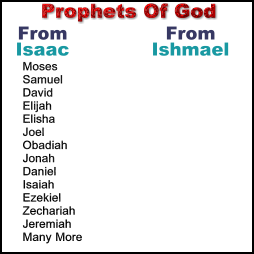
The standard Islamic answer to these discrepancies is the charge that the Jews and Christians, the agents and bearers of the Scriptures, had somehow changed and distorted the true message from God. But the obvious question is this: when did this supposedly happen, and what is the evidence? In the foundational story of Isaac and Ishmael, the account recorded by Moses existed for many centuries before Mohammad, and the historical basis for it was not disputed for 2,600 years. In fact, there is no evidence that anyone at anytime before Mohammad claimed that it would be Ishmael, not Isaac, who would inherit the covenant promises granted by God to Abraham. This is true of all of the many starkly contradictory teachings of Mohammad - no evidence whatsoever exists that the earlier prophets had been given a pure message from God which was later distorted into the form it now stands in the Bible. There simply is no evidence for Islam's absurd assertion.
It is compassion and mercy, not militaristic conquest, which is the essence of God's redemptive message to mankind. The ultimate provision of the covenant God made with Abraham to bring blessings to all the world was through the promised Messiah. He was prophesied to be a descendant of Abraham, Isaac, Jacob, Judah, and David, and would appear the first time to give his life as a sacrifice of atonement for sins. It is He who would be the culmination of the Word of God communicated to all the world.
"The Word became a human being and lived here with us. We saw his true glory, the glory of the only Son of the Father. From him all the kindness and all the truth of God have come down to us.... No one has ever seen God. The only Son, who is truly God and is closest to the Father, has shown us what God is like." (John 1:14,18 CEV)
King David prophesied this 1000 years before Jesus came about David's descendant who would become the King of the Earth:
"The one enthroned in heaven says...'I have appointed my own king to rule in Jerusalem on my holy mountain, Zion.' Now I will tell you what the Lord has declared: He said to me, 'You are my Son. Today I have become your Father. If you ask me, I will give you the nations; all the people on earth will be yours. You will rule over them with an iron rod. You will break them into pieces like pottery." (Psalms 2:4,6-8 NCV)
The prophet Isaiah, 700 hundred years before Jesus was born, described the Messiah who would be a descendant of King David (whose father was Jesse of Bethlehem):
"A shoot will come up from the stump of Jesse; from his roots a Branch will bear fruit. The Spirit of the LORD will rest on him-- the Spirit of wisdom and of understanding, the Spirit of counsel and of power, the Spirit of knowledge and of the fear of the LORD-- and he will delight in the fear of the LORD. " (Isaiah 11:1-3 NIV)
That man from Galilee, Jesus of Nazareth, is the great light to illuminate God's final message to the world, and no more prophets are needed after him.
"In the future he will honor Galilee of the Gentiles, by the way of the sea, along the Jordan-- The people walking in darkness have seen a great light; on those living in the land of the shadow of death a light has dawned.... For to us a child is born, to us a son is given, and the government will be on his shoulders. And he will be called Wonderful Counselor, Mighty God, Everlasting Father, Prince of Peace. Of the increase of his government and peace there will be no end. He will reign on David's throne and over his kingdom, establishing and upholding it with justice and righteousness from that time on and forever. The zeal of the LORD Almighty will accomplish this." (Isaiah 9:1-2,6 NIV)
You may dispute these facts, and it matters not to me if you do, for the truth stands by itself. But it would be to your benefit if you set aside your religious zeal and reexamine the accuracy of what you have been taught. It may be that the true God, the God of Abraham, is giving you this one chance to discover Him in truth. The God of Abraham, Isaac, and Jacob is a God who wishes to have a personal relationship with all humans who have been made in His image. Sadly, mankind has invented many errant religions which do not lead people to God, but away from Him. You may be very fervent in your religion, but if a religion is based on fallacies, it is worse than useless.
His message is not confused and contradictory, The Father sent the Son to be the savior of the world, as all the prophets had foretold. Believing in the authority of the Son is the only way to know the true God and have eternal life. As Jesus said,
""I tell you the truth, whoever hears my word and believes him who sent me has eternal life and will not be condemned; he has crossed over from death to life. I tell you the truth, a time is coming and has now come when the dead will hear the voice of the Son of God and those who hear will live. For as the Father has life in himself, so he has granted the Son to have life in himself." (John 5:24-26 NIV)
The Land Covenant
In the Bible, we are often reminded of the power and greatness of God through the marvelous acts he accomplished in history.
"Give thanks to the LORD, call on his name; make known among the nations what he has done. Sing to him, sing praise to him; tell of all his wonderful acts. Glory in his holy name; let the hearts of those who seek the LORD rejoice. Look to the LORD and his strength; seek his face always. Remember the wonders he has done, his miracles, and the judgments he pronounced, O descendants of Abraham his servant, O sons of Jacob, his chosen ones. He is the LORD our God; his judgments are in all the earth. He remembers his covenant forever, the word he commanded, for a thousand generations, the covenant he made with Abraham, the oath he swore to Isaac. He confirmed it to Jacob as a decree, to Israel as an everlasting covenant: "To you I will give the land of Canaan as the portion you will inherit."" (Psalms 105:1-11 NIV)
It was not to Ishmael's descendants this promise was made, but to Isaac and Jacob's. Ishmael's descendants also became a nation, as God promised, and settled further to the east in Arabia. But the land of Canaan was given only to Israel's descendants.
There were conditional clauses in the Torah in which God warned Israel they could temporarily lose possession of that land if they were not faithful to God. That is indeed what happened, for the very long period of nineteen centuries from 70 AD until 1948 AD. But the Psalm above, as well as other Biblical references, affirms though Israel might lose temporary possession of the land, they would never lose the permanent inheritance.
In fact, one of the most frequently mentioned promises of God in the Bible is the eventual return of the Jews to their own covenant land. For anyone looking for proof that the God of the Bible exists and His declarations are trustworthy, this improbable fact is a very good starting point.
"Listen to me, you nations nearby or across the sea. I scattered the people of Israel, but I will gather them again. I will protect them like a shepherd guarding a flock; I will rescue them from enemies who could overpower them. My people will come to Mount Zion and celebrate; their faces will glow because of my blessings." (Jeremiah 31:10-12 CEV)
This declaration from the prophet Jeremiah could not be clearer. Israel would be regathered in spite of overwhelming and fierce opposition from enemies who tried to stop the process. The land would once again belong to them, because the God who promised it to them at the beginning was resolved to carry through His intentions.
Who are those "enemies" who attempt to stop this process? It is no coincidence many are related to the nation of Ishmael. The intense hatred expressed towards Israel was initially expressed in the resentment of Hagar, that her son Ishmael would not share the covenant promises with Isaac. But the modern expression of that hatred is conveyed through another religion that arose first among the Arab descendants of Ishmael - Islam. It is a fallacious religion which has emerged as a hostile rival to the God of Israel and to His promises to Abraham.
Eventually, those returning Jews became a nation once again, accomplishing what God had promised many times in the Bible. In 1948 and again in 1967, God executed great victories for Israel, regaining more and more of their covenant land. These were the first steps to restore, in stages, the land God promised them. This gradual repossession is direct fulfillment of what many prophets of the Bible said would happen. But the process is not over yet - God will continue to show His greatness by the final recovery of all the land promised to Israel, and the expulsion from that land of all who oppose this. The religion Mohammad invented which propels that vicious opposition will, as a result, be discredited as an impotent farce. I believe many who had been blinded by that cruel religion will come to know the true God.
"Remember the wonders he has done, his miracles, and the judgments he pronounced." When we look at the history of Israel, we see many examples of these. Those examples refute those who smugly assert there is no evidence of God acting in history. Yet God's actions have not ceased in our time. For all with an open heart, His actions on Israel's behalf today - those wonders, miracles, and judgments - are happy confirmation of His power and greatness!
The Triumph Of Zionism
Zionism is a term which is emotionally charged and poorly understood. At the simplest level, it describes the return of the Jews back to their promised land after centuries of exile, to form a new nation. That nation, and the concept of Zionism, are vilified by many. One would think after sixty-plus years the legitimacy of Israel would not be in question, but sadly that is not the case. Yet even among those who would not have the audacity to openly question Israel's legitimacy, a great deal of hostility exists.
Much of that hostility originates in the Muslim world, where the concept of Zionism is almost universally regarded as repugnant. They detest the existence of a Jewish state on what they consider Arab and Muslim land. Zionism is regarded as an affront to their religion and their "god". It is not an exaggeration to state the elimination of the nation of Israel is a dominant theme among Muslims.
The Islamic anger at Israel is accentuated by the defeats they have suffered whenever they have tried to destroy Israel. Immediately after the founding of Israel in 1948, several Muslim armies attacked, and failed. Over the years, those attempts have changed in tactics, but still have not ceased, as we all know too well. The emergence of violent, extremist, jihadist Islamism in both Shia and Sunni Islam has become a driving force behind the efforts to destroy Israel.
No one expresses the Islamist hatred of Zionism more forcefully than the Iranian maniac Mahmoud Ahmedenejad. Here are some of the droppings from his mouth: "The Zionist regime is counterfeit and illegitimate and cannot survive." "The Zionists and their protectors are the most detested people in all of humanity, and the hatred is increasing every day." "The Zionist regime is an injustice and by its very nature a permanent threat. Whether you like it or not, the Zionist regime is heading toward annihilation. The Zionist regime is a rotten, dried tree that will be eliminated by one storm." "Israel must be wiped off the map. The establishment of a Zionist regime was a move by the world oppressor against the Islamic world ."
And while Zion-hatred persists and intensifies through ever more radical Islamist ideologies, Zion-hatred originating in the non-Muslim world intensifies as well. It appears the collective guilt over the Holocaust which had restrained antisemitism has now run its course. The haters who poorly masquerade as "peace activists" do all they can to demonize Israel, yet loudly protest they are not anti-Jew, only anti-Zionist. For them, it is only Jews who dare step outside of their designated boundaries of behavior who are the object of scorn. How dare they think they could have their own uniquely-Jewish nation!
Indeed, those who conform to the world's circumscription, those Jews who are embarrassed about the existence of Israel and the Biblical pronouncements regarding its reestablishment, are more than welcome among the anti-Zionists. However, those "impudent" Jews who have the audacity to insist on and defend their own homeland, they are the ones who are scorned by the academics and power brokers and intelligentsia.
To justify their enmity, the pugnacious pro-Palestine pundits use terms like "colonialist", "oppressor", "occupier" to describe those Jews who until recently could do little but play the victim. But now that Jews can take a stand on their own land to defend their own people, their former tormentors foam at the mouth in rage against the "insolent" Zionists.
To a great extent, the sympathy for the Palestinians which some invoke to hurl their spite towards Israel, is only a pretext for that spite. It's much more acceptable in some circles to express extreme anti-Zionist disgust when speaking on behalf of a supposed victim. But pro-Palestine sentiments are largely a ruse to disguise the real issue - that Israel exists, and cannot be allowed to stand.
Yes, Israel has become a nation once again, and stand it will. Does that mean Zionism is complete? No, it is not, for two reasons. First, all of the land designated for the Jews is not yet in their possession. Second, there are spiritual aspects of Zionism yet to be fulfilled. Those two reasons are intertwined, for according to the Biblical prophets, God's ultimate spiritual regeneration of Israel would only happen when they are completely restored to their complete geographic inheritance.
A complete vision of Zionism would incorporate the prophetic spiritual aspects of the Biblical mandate. This was summarized by the Psalmist: "You, O LORD, sit enthroned forever; your renown endures through all generations. You will arise and have compassion on Zion, for it is time to show favor to her; the appointed time has come. For her stones are dear to your servants; her very dust moves them to pity. The nations will fear the name of the LORD, all the kings of the earth will revere your glory. For the LORD will rebuild Zion and appear in his glory." (Psalms 102:12-16 NIV)
The early Zionists were pragmatic people. They were concerned primarily about the immediate daunting political obstacles, and, once in the land, the exhausting physical tasks they faced daily. But a few people saw a broader vision, most notably, David Ben Gurion. Perhaps one of the reasons he rose to prominence was his ability to articulate a mode of Zionism which encompassed the lofty spiritual aspects.
Ben Gurion was not a religious man, of course, but he was an avid reader of the Scriptures. He was not at all hesitant to refer to the Bible when attempting to inspire and strengthen his fellow Jews in their Zionist endeavors. And his citations of the Holy Scriptures were not wielded in an insincere manner as merely a political tool, but in sincere, heartfelt belief.
Since that time, Zionism has sorely lacked this kind of prominent clarion voice echoing the prophets of the Almighty. Perhaps this is a reason why the Zionism of today has lost much of its clout. Assailed relentlessly for decades by the intellectual left, Zionism has only weakly defended itself. A key reason for that weakness: the leaders have largely ignored its true, noble, prophetic basis.
Ben Gurion seemed to have understood the Hebrew prophets did not just write quaint aphorisms, but were in a very real sense seeing what would happen in modern times to the Jewish people. Their lofty, passionate declarations often sound like they could have been written last week rather than dozens of centuries ago.
Yet contemporary Zionism often seems almost ashamed of the prophetic pronouncements. Many Jews today seem to prefer to make their case for the rights to the land on any basis but the Biblical one. This is presumably for two reasons, one, a concern of how this would be received by the world audience, and two, many still do not put much genuine credence in the sayings of the prophets.
'"In those days, at that time," declares the LORD, "the people of Israel and the people of Judah together will go in tears to seek the LORD their God. They will ask the way to Zion and turn their faces toward it. They will come and bind themselves to the LORD in an everlasting covenant that will not be forgotten. My people have been lost sheep; their shepherds have led them astray and caused them to roam on the mountains. They wandered over mountain and hill and forgot their own resting place."'(Jeremiah 50:4-6 NIV)
The "resting place" they forgot was not their land, but their God. The Biblical prophets were repeatedly very clear about the cause of the extended exile from the land. And the way back to the land is the way back to their God. Will this new kind of Zionism, this asking of "the way", be reserved for those in Israel who are regarded as religious? No, not at all. In fact, it is very probable it will take root more quickly among those who do not consider themselves as religious.
In the same manner that Ben Gurion could clearly see the wisdom of the prophets without fitting into the category of the "religious," so too a new generation of Israelis will awaken to the new kind of Biblical Zionism. They will look outside their traditional religious systems, eschewing them as not helpful in their pursuit of the Almighty. Casting their eyes upward, they will look to their Maker anew for answers, answers their own rabbis, the "shepherds who led them astray", could not provide.
"The people will be secure in their land. They will know that I am the LORD, when I break the bars of their yoke and rescue them from the hands of those who enslaved them. They will no longer be plundered by the nations, nor will wild animals devour them. They will live in safety, and no one will make them afraid. I will provide for them a land renowned for its crops, and they will no longer be victims of famine in the land or bear the scorn of the nations. Then they will know that I, the LORD their God, am with them and that they, the house of Israel, are my people, declares the Sovereign LORD. You my sheep, the sheep of my pasture, are people, and I am your God, declares the Sovereign LORD." (Ezekiel 34:27-31 NIV)
This is not dissimilar what He did for Israel at the time of Moses, when He redeemed them from a terrible plight in response to their calls to Him. As King David recalls,
"And who is like your people Israel--the one nation on earth whose God went out to redeem a people for himself, and to make a name for yourself, and to perform great and awesome wonders by driving out nations from before your people, whom you redeemed from Egypt? You made your people Israel your very own forever, and you, O LORD, have become their God." (1 Chronicles 17:21-22 NIV)
We all know God selected our father Abraham to make a great nation of him, to bring the knowledge of the true God to all nations. In the Bible, it says the primary reason God has returned Israel to the land after these many days is to bring renown to Himself, to show the world that the God of Israel is still actively working on their behalf, even during this time of trouble.
This is why a new kind of Biblical Zionism is a necessity, and an inevitability in Israel. It is a necessity because there is no other solution for Israel's increasingly dire, unsolvable situation. It is an inevitability because the prophets foresaw it. They foresaw a new spiritual awakening of the Jewish people in the end times. This awakening is spoken of in the same breath as the predictions of the return to the land, in conjunction with the return. The old Zionism served its purpose, but its purpose is now complete. The time for the new Zionism has arrived.
This Zionism will be a movement of passionate and genuine seeking of God, the kind of mindset that characterized the life of David as he become the preeminent ruler of Israel. It will not be a movement of ritual form or external practice, but a movement of the heart.
God Himself is passionate for Zion, and His personal passion will be the compelling force behind the new Zionism. He is "very jealous for Zion, is consumed with jealousy for her," according to Zechariah. That passion will work against all of the haters of Zion, who are violently determined to stop His purposes.
"They have greatly oppressed me from my youth-- let Israel say-- they have greatly oppressed me from my youth, but they have not gained the victory over me. Plowmen have plowed my back and made their furrows long. But the LORD is righteous; he has cut me free from the cords of the wicked. May all who hate Zion be turned back in shame." (Psalms 129:1-5 NIV)
Great Miracle of Hanukkah
At every critical point in Jewish history, there has been an opponent dedicated to their destruction. After the Greek Empire of Alexander the Great had been divided up into 4 pieces (which had been prophesied in the Bible), Judea came under the power of the Seleucid Empire of Syria. A particularly sinister ruler (also prophesied in the Bible), Antiochus IV Epiphanes, invaded Jerusalem, massacring many Jews. He made it his objective to obliterate everything related to Jewish worship of their God. "A man could not keep the sabbath or celebrate the traditional feasts, nor even admit that he was a Jew." (2nd Maccabees 6)
In mosques all around the world, Jews are regularly vilified. It is a part of explicitly stated Islamic "theology" that the Jews must ultimately be eradicated. Like all prior attempts to do that, this one will not succeed, because the God of Abraham, Isaac, and Jacob will most decidedly not allow it. And we also know, based on commentary from God Himself in the Bible, that He has made His defense of the Jewish nation a showpiece, to demonstrate to the entire world once again who He is.
Wow - "that all the earth may know"! Clearly young David had a remarkably greater understanding of the larger theme behind what was happening. And it is with that kind of understanding we must examine Israel's primary foe today.
Looking with the larger perspective, we know that during the days of David, and Esther, and the Maccabees, and Ben Gurion, and other crisis situations, it was ultimately the Lord of Hosts who accomplished the victory to save Israel. Not surprisingly, the Scriptures do describe in detail today's predicament of the regathered nation of Israel being threatened by their vicious neighbors, and the Lord's ultimate great victory on their behalf.
So as we celebrate Hanukkah, remember the great miracle which happened was not primarily the oil lasting for eight days, but the nation of Israel lasting through the threat of annihilation. Today they face a foe no less sinister and powerful than Antiochus IV, but the God of Jacob will prevail.